Universal health coverage in Africa: WHO calls for faster progress
- Posted on 16/09/2026 11:24
- Film
- By raymonddzakpata@sante-education.tg
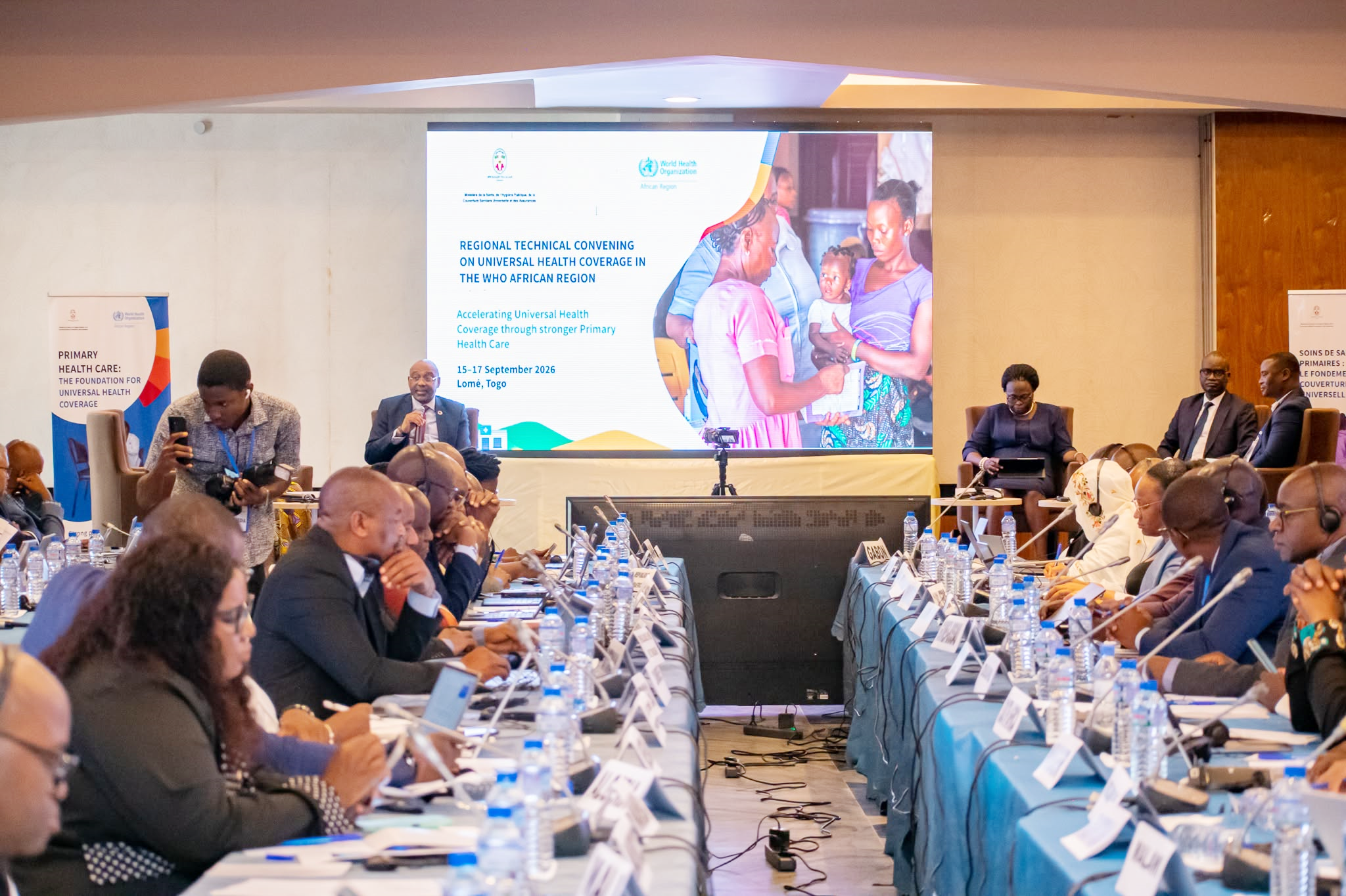
Extract from the article: The World Health Organisation (WHO) Regional Office for Africa is organising a technical meeting in Lomé from 15 to 17 September 2026 to review the experiences and commitments made by the ministries of health of the 47 Member States of the WHO....
The
World Health Organisation (WHO) Regional Office for Africa is organising a
technical meeting in Lomé from 15 to 17 September 2026 to review the
experiences and commitments made by the ministries of health of the 47 Member
States of the WHO African Region towards universal health coverage (UHC). The
meeting will bring together planning directors and senior officials from the
ministries of health of the Member States of the WHO African Region, WHO health
policy advisers, technical officials from the Organisation, and partners. It
aims to take stock of progress towards UHC, examine the main obstacles
hindering progress, and identify the priorities and concrete actions needed to
accelerate progress between now and 2030 and beyond.
Despite
the progress made in access to essential health services in the WHO African
Region, population growth is outpacing these advances. The number of people
without full coverage by essential health services has risen from 576 million
in 2017 to around 609 million in 2025. According to projections, this figure
could reach 652 million by 2030 if the current pace of progress remains
unchanged. This trend highlights a major challenge for the Region: the progress
made is not yet fast enough to meet the needs of a rapidly growing population.
Financial
protection also remains a major challenge. The proportion of the population
facing financial hardship due to healthcare expenditure remains virtually
unchanged, averaging around 33 per cent between 2017 and 2025. Due in
particular to population growth, the number of people affected is projected to
rise from 391 million in 2017 to 491 million in 2025 and could reach 561
million by 2030.
No country is expected to reach an
index score of 80 by 2030
Since
the adoption in 2017 of the Regional Action Framework for Universal Health
Coverage, countries in the Region have made significant progress. The number of
countries with a service coverage index below 40 has fallen from 17 in 2017 to
just two in 2025.
However,
the majority of countries still fall within the 40–59 range. Based on current
trends, no Member State is expected to reach a coverage index of 80 by 2030.
‘The African Region has demonstrated that it
is possible to make progress towards universal health coverage. But the data
clearly show that the current pace will not be sufficient. We must accelerate
progress, strengthen primary health care and ensure that everyone can access
the quality care they need without facing financial hardship. At the same time,
our approaches must take into account the specific realities and needs of the
different countries in the Region,” said Dr Abdourahmane Diallo, Director
of Programme Management at the WHO Regional Office for Africa.
Geographical accessibility is
improving in Togo
Togo
also faces significant challenges on its path towards universal health
coverage.
Speaking
on behalf of the Minister of Health, Dr Josée Yawa Djatugbé Apetsianyi,
Director-General of Health Studies, Planning and Information (DGEPIS),
highlighted two main challenges: geographical accessibility and financial
accessibility to health services. In geographical terms, Togo has made
significant progress. “Today, the rate of
geographical accessibility to health services stands at 90.7 per cent,” she
stated. This means that less than 10 per cent of the population lives more than
five kilometres from a health centre. This improvement is largely due to the
investments made in recent years by the Togolese government with the support of
its partners. The second challenge concerns financial accessibility to care.
Primary healthcare at the heart of
the acceleration
Strengthening
primary healthcare will be at the heart of this new phase. Effective primary
healthcare brings high-quality, integrated and continuous health services
closer to people and communities.
Accelerating
progress towards UHC will also require strengthening financial protection,
ensuring that the number and skills of healthcare workers are commensurate with
needs, guaranteeing reliable access to essential health products and
technologies, and improving the use of data to inform decision-making.
Over
the course of the three-day meeting, countries will review the available data
and share their experiences in order to identify approaches that work, areas
where progress has been made, and the changes that are still needed.
Raymond DZAKPATA & Eméline
DJESSOU (Stagiaire)