
HIV Response: 68% Reduction in New Infections, Encouraging Progress for Togo
- Posted on 02/12/2025 12:55
- Film
- By raymonddzakpata@sante-education.tg
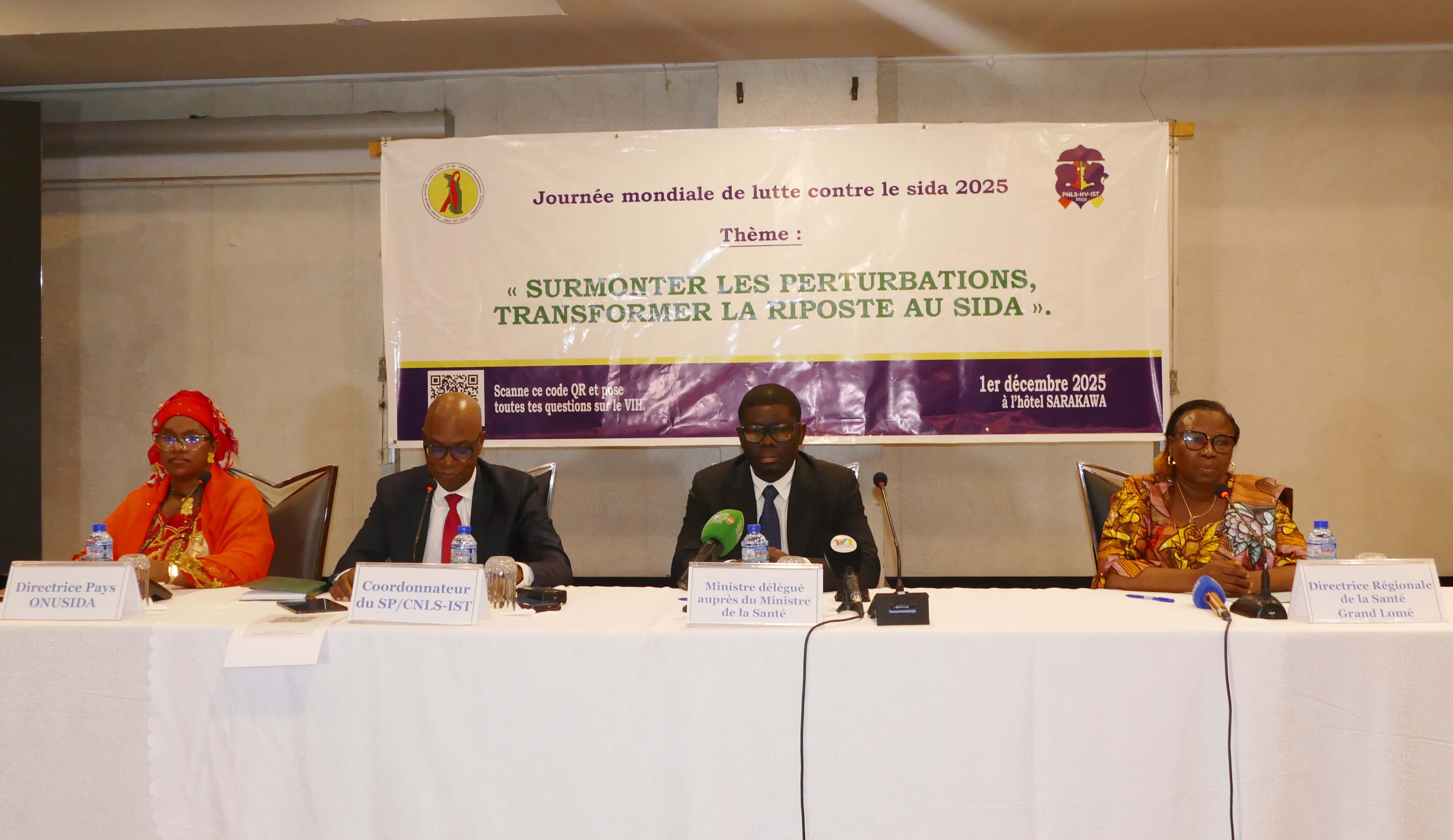
Extract from the article: The international community celebrated World AIDS Day, held every year on December 1st, as a moment to assess progress, identify ongoing challenges, and renew global commitments against HIV. In Togo, the commemoration was marked by a press....
The
international community celebrated World AIDS Day, held every year on December
1st, as a moment to assess progress, identify ongoing challenges, and renew
global commitments against HIV. In Togo, the commemoration was marked by a
press conference organized by the National Council for the Fight Against AIDS
and STIs (CNLS). The meeting was chaired by the Minister Delegate to the Ministry of Health,
Professor Tchin Darre, on Monday, December 1, 2025, in Lomé.
Under
the global theme “Overcoming Disruptions, Transforming the AIDS Response,”
the 2025 edition calls on countries to strengthen the resilience of their
health systems, which have been severely affected by multiple crises—pandemics,
conflicts, economic pressures, and disruptions to essential services. The goal
is to build a more inclusive, durable, and disruption-resistant HIV response.
Togo
adopted a complementary and strategic national theme: “Let’s Mobilize for
the Triple Elimination of HIV, Syphilis, and Hepatitis B in Children.” This
aligns with regional commitments to eliminate three mother-to-child
transmissible infections simultaneously—an important public health priority.
Before civil society actors, media professionals, and partners, CNLS presented
updated data on the national HIV response for 2024. “Togo has made significant
progress in the fight against HIV thanks to the commitment of the government
and its partners, resulting in a substantial reduction in morbidity and
mortality and an improvement in life expectancy. Diagnostic and treatment
services now meet standard norms, offering real relief to the population,” said
Professor Tchin Darre.
Screening
and Prevention: Sustained Efforts
According
to CNLS, 594,329 people were tested for HIV in 2024. Additionally, more
than 16 million condoms were distributed nationwide, reflecting stronger
prevention efforts.
Data
show a significant decline in new infections—from 6,300 in 2010 to 2,100
in 2024, a 68% decrease over 14 years. AIDS-related deaths also
dropped to 1,800 in 2024, representing another 68% reduction
since 2010. Among children aged 0–14, the decline reached 69%.
Togo
Nearing the “95-95-95” Global Targets
CNLS
highlighted progress in access to antiretroviral therapy (ART). In 2024, Togo
achieved:
- 92% of people
living with HIV knowing their status
- 99% of those aware
of their status on ART
- 92% of people on
ART with viral suppression
These
results place the country close to the global 95-95-95 targets aimed at
controlling the epidemic by 2030.
A
Persistent Concern: Mother-to-Child Transmission
Despite
progress, the prevention of mother-to-child transmission (PMTCT) remains a
challenge. The CNLS reports a 13% transmission rate, nearly three
times higher than the national target of 5%. This is attributed to
disruptions in prenatal services, late or insufficient testing among pregnant
women, limited adherence to treatment, and unequal access to health services in
rural areas.
The
triple elimination of HIV–Syphilis–Hepatitis B remains a major objective
for the coming years.
A
Call for Vigilance: Sustaining Efforts
In
his message, CNLS Coordinator Professor Pitché Vincent called for
continued mobilization: “The fight against HIV continues. Even though the situation in Togo is encouraging, every service interruption, every undiagnosed person, and every treatment not followed can reverse the progress.”
This
highlights the importance of regular HIV testing, consistent supply chains,
stigma reduction, and sustainable financing of the national response.
Togo’s
progress is significant, but challenges—particularly PMTCT—require coordinated
action from the government, partners, health professionals, community
organizations, and the population itself.
Raymond
DZAKPATA