
Plastic packaging: the silent killer
- Posted on 19/04/2023 18:27
- Film
- By abelozih@sante-education.tg
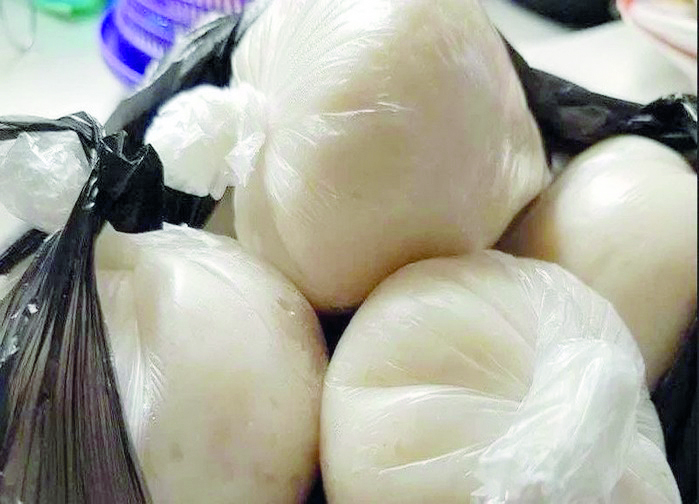
Extract from the article: In Togo, many people buy their hot food in plastic bags and packaging. This common practice unfortunately carries health risks. Using plastic bags to package hot food leads to contamination with antimony or Bisphenol A, which are carcinogenic compoun
In
Togo, many people buy their hot food in plastic bags and packaging. This common
practice unfortunately carries health risks. Using plastic bags to package hot
food leads to contamination with antimony or Bisphenol A, which are
carcinogenic compounds.
When
buying a meal, most people use plastic bags. There is no need to drag dishes
around. Just find a bag and you're done. Whether it's rice, beans, « Akpan »,
« Kom », or doughnuts, everyone recognises themselves. We are even
the first to ask for plastic packaging. For Afoua Salifou, 30, a porridge
seller in Agoè Démakpoè, it is a question of notorious laziness on the part of
customers, who often say that the bowls, cups and plates are too heavy for them
and prefer to buy porridge in bags. « The fault is not with us good
women because we only respond to the demand of our customers. It is what the
customers ask for that we do. And there are even some who get angry when we
don't have the bag when we sell », she said. It is also noticeable
that some employees, workers or craftsmen who go to work, buy their food from
home in bags because in their work area there is not enough food and the little
that is available is expensive.
Some
customers even ask for double the packaging to hide the food well. They say
that the bags are quite available in the markets. For 250 francs, you can buy a
pack of 100 small plastic bags, commonly called « white plastic »,
which is most commonly used in shops and in households.
Composition
of this packaging
Plastics
are organic materials made up of macromolecules. Plastics are derived from petroleum. They are
polymers obtained by polymerisation, starting from a single molecule with the
aim of making this molecule hook up with its identical neighbours to form a
large chain of molecules called a macromolecule. Plastics are made up of
elements such as carbon, hydrogen, oxygen, nitrogen and sulphur, and are mainly
derived from oil or natural gas. The manufacture of plastic bags and packaging
requires the use of substances such as: polyethylene (used in the manufacture
of plastic bottles and packaging), antimony, bisphenol-A, polyvinyl chloride
(used in the manufacture of supermarket packaging), polycarbonate (used in the
manufacture of baby bottles, cups and water bottles), which are very dangerous
to human health.
Plastic
and heat
The
problem is that plastics have an enemy: heat. Indeed, the danger of plastics
comes mainly from the additives, solvents, catalysts and other chemicals that
are used to cause polymerisation, to tint, or to modify the properties of
plastics. Most of the time, the negative effects come from the thermal
degradation of plastics (when they are heated or burned). This releases
chemicals into the parts in contact with the plastic or into the air (in the
case of burning). Depending on the chemicals and the amount ingested, there are
greater or lesser health risks.
Beware,
it's a poison
According
to studies by the United Nations Environment Programme (UNEP), plastic is a
poison for the environment and human health. Indeed, more than 400 million
tonnes of plastic are produced worldwide every year. However, micro-plastics
turn into tiny plastic particles and enter our food, water and air. Each person
on the planet consumes more than 50,000 plastic particles per year. According to a rice waitress at the
University of Lomé, « when you put hot products in the bags, these
substances dissolve quickly. If it's food, it's clear that it becomes poison.
We must be careful or limit their use as much as possible ».
Swallowing hot food sometimes causes digestive problems due to the toxicity of
these overheated plastic bags. When we wrap rice, couscous or beans in plastic,
when we unpack we get a little layer of oil on the food we are going to eat.
This layer of oil is nothing more than the liquefied hydrocarbon that prevents
the plastic from being used, which itself is made from hydrocarbon waste. As a
result, we consume toxic products. Plastic releases what are known as endocrine
disruptors into the water. Their effects at very low doses are still little
understood. However, studies have shown that packaging hot food in plastic bags
increases contamination with carcinogenic compounds and substances. When in
contact with food, it leads to the production of phthalates, carcinogenic
substances whose dose increases with the length of storage. The use of black
bags is not far from being a poison. According to Christian Konfo, nutrition
teacher at the Ecole Polytechnique d'Abomey-Calavi (EPAC) in Benin and at the
Faculty of Agronomic Sciences, « the petroleum origin of the sachet
means that the major risk to which the consumer is exposed is cancer, because
black sachets are essentially made up of alkene. Other parallel consequences
are the ingestion of lead and carbon monoxide ».
Christian
Konfo, believes that lead introduced into the body in any form is highly toxic.
« The effects of this metal, which can be released by the heat of the
food in the bag, are usually felt after a period of accumulation of the metal
in the body. Poisoning manifests itself in the form of anaemia, sexual
weakness, constipation and colic. Carbon monoxide is a terrible poison. If
inhaled, it combines almost irreversibly with the haemoglobin in the blood
instead of carbon dioxide, causing anoxia and leading to asphyxiation. The
release of Carbon Monoxide only follows a high temperature heat treatment such
as making fire with the bag », explains the nutrition teacher.
Alert
on chronic diseases
Numerous
studies show that toxic elements present in the manufacture of plastic can
migrate into a hot food. The ingestion of such a meal sometimes causes
pathologies due to the toxicity generated by these overheated plastics.
According to Mathieu Tobossi, Specialist in Food Hygiene and Quality, even non-hot foods are also subject to particle transfer. These are often soft plastics or PVC which are rich in dioxins and phthalates that are likely to transfer materials to the food they contain, even though they are not hot, and so the longer the food remains in the plastic, the more the particles start to pass into the contents.
« If
we take the materials that have been added to plastics to help them be soft,
strong, unbreakable, flexible, we have what is called bisphenol A. Bisphenol A is much more dangerous from a
reproductive point of view. It is a "reprotoxic" material. That is to
say, in men it makes them infertile. Because it causes what is called endocrine
disruption. Endocrine disruption causes sperm disruption. The testicles will
totally lose their volume. This leads to testosterone disorders, as
testosterone is the main hormone in men. Bisphenol A also causes sexual
weakness », explains Mathieu Tobossi. In women, there
is polycystic ovarian syndrome. Women have menstrual disorders. « Menstruation
skips 2-3 months and then comes back. With this she cannot ovulate, fertilise
or conceive. There is also endometriosis which gives pain that is not possible
during menstruation », he says.
« When
we take another material that is used to make plastics, we have polypropylene.
Polypropylene allows the plastic to be strong, to be tear-proof and to be
recyclable. When polypropylene meets bisphenol A in a plastic, and both migrate
into the meal, the woman who eats the meal is at risk of developing breast
cancer », says Mathieu Tobossi.
There
is also another material called phthalates. This material has the property of
making plastic flexible. According to the specialist in food hygiene and
quality, « if this material accumulates in fats, then it diffuses into
the gastrointestinal system. It spreads to the liver, kidneys, muscles, lungs,
testicles and breast milk in nursing mothers. So the baby is exposed. Phthalates also have a teratogenic effect,
i.e. they can cause malformations in the foetus. Children who are born with six
fingers, with cleft lips, feet that are not in shape. There is also a reduction
in the weight of the foetus. »
A
fourth molecule that can be found in plastic bags is dioxins. The specialist
says that dioxins are highly carcinogenic and hormone disruptors to the point
that reproduction is disrupted - everything related to hormones is disrupted.
Dioxins also cause an immune system disorder.
So
what can be done?
There
is no magic solution. « The first precaution is to raise awareness. If
the person who uses the plastic material does not know the risk or the health
danger he is running, he cannot resolve to get rid of it or to be wary of
it. Secondly, when we go to buy hot food
in plastic bags, we must quickly transfer them to stainless steel, porcelain,
glass and other containers once we get home. This is to avoid that the duration
or the contact time causes particles in the food that we want to consume »,
says Mathieu Tobossi, Specialist in food hygiene and quality.
To
limit the real damage caused by the use of plastic bags in the country, it is
up to everyone to make an effort to limit their use as much as possible. At the
University of Lomé, for example, since the beginning of the 2019-2020 academic
year, the use of black plastic bags has been banned.
« You
have to throw away plastic packaging that shows signs of wear or degradation
and avoid consuming the contents. The plastic cutlery, dishes, knives, forks
that we have in our homes, we must get rid of them, they are dangers that we
carry in our kitchens », the specialist insists.
It
is also important to prefer foods like « Akpan », « Egblin »,
« Ablo » preserved in leaves. « When we put heat in the leaf,
there will be a transfer of therapeutic properties in that food because when we
take the leaves and when we brew them or expose them to heat, we can get out
therapeutic particles. If you eat 'akpan', 'Egblin' or 'Ablo' in the banana
leaf, cassava leaf or teak leaf, you also have a better chance of treating
yourself indirectly. I prefer to use the leaves. If the leaves are well washed,
disinfected, the risk of infection is less because the heat in contact with the
microbes that could be found on these leaves with a little time the microbes
will be destroyed and therefore the meal will be idem of great danger »,
recommends Mathieu Tobossi
Abel
OZIH & Joseph GANGUI