

The fate of donated blood: a rigorous process
- Posted on 22/11/2025 12:31
- Film
- By kolaniyendoumiesther@gmail.com
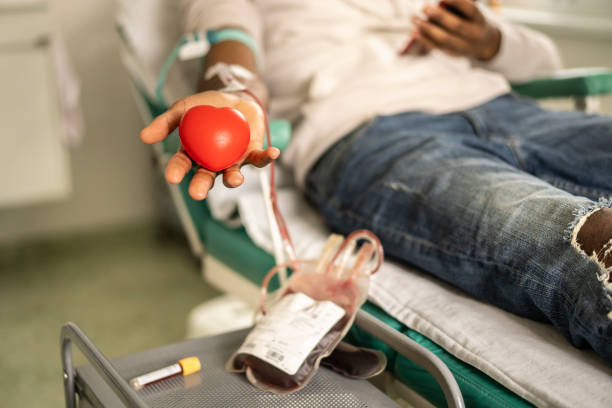
Extract from the article: Collected blood is a vital resource that requires strict management to ensure the safety of recipients and donors themselves. Blood transfusions at the National Blood Transfusion Center (CNTS) in Lomé are based on a rigorous protocol. This proc...
Collected blood is a vital resource that requires strict management to ensure the safety of recipients and donors themselves. Blood transfusions at the National Blood Transfusion Center (CNTS) in Lomé are based on a rigorous protocol. This process is long and demanding. It involves volunteer donors, qualified staff, and significant technical resources to ensure product compliance.
First,
the production of labile blood products (LBP) requires constant monitoring. The
cost of producing a bag of blood is estimated at between 50,000 and 60,000 CFA
francs. This resource is precious. The sustainability of reserves depends on
optimized management.
From
collection to biological testing
The
journey of a blood bag begins with the Information, Education, and
Communication (IEC)-Collection stage. After raising awareness, welcoming the
donor to the collection site (fixed or mobile), conducting an interview and
pre-donation examination, the collection is performed. This involves taking two
blood samples in tubes and one in a blood bag. The blood bags are then sent to
the preparation department and the samples to the Donor Biological
Qualification (DBQ) laboratory.
Next,
the DBQ is an essential testing stage. It is divided into two laboratories. In
the Immunohematology laboratory, blood typing is performed on all blood
donations. In addition, compatibility tests are carried out there if they
cannot be performed in hospital blood bank laboratories. Meanwhile, the
Serology Laboratory tests for the presence of infectious agents that can be
transmitted through blood, including HIV, Hepatitis B, Hepatitis C, and
Syphilis. Finally, all test results are transferred to the transfusion
management software.
Preparation,
validation, and destination of bags
In
conjunction with the biological qualification of the donation, blood products
are prepared. Whole blood bags are centrifuged to separate the blood into its
various components, known as labile blood products (LBP). At the CNTS, red
blood cell concentrate, fresh frozen plasma, and platelet concentrates are
produced.
The
release of the products then depends on the laboratory results. The control
software cross-references the information for each prepared product with the
laboratory results.
There
are then two possible scenarios:
If
the product is valid: The software reports that the product is
compliant. A specific label is printed and affixed to the bag. This label
indicates the nature of the product, the blood type, and the expiration date,
among other information, and the product is transferred to distribution to be
delivered to patients.
If
the product is disqualified: The identification label
cannot be printed. The bag is then removed from the transfusion circuit and
enters the incineration destruction circuit.
The
storage period for blood products varies. Red blood cell concentrates can be
stored for about one month. Fresh frozen plasma, on the other hand, can be
stored for up to one year.
To donate blood, go to:
- The National Blood Transfusion Center (CNTS), located
in Doumasséssé, near the Doumassessé II public elementary school and the EAMAU.
The center is open Monday through Friday from 7:30 a.m. to 6 p.m. and Saturday
from 8 a.m. to 1 p.m. Toll-free number: 8214.
- PCD Tokoin, located in the Sylvanus Olympio University
Hospital behind the hemodialysis department: open Monday to Friday from 7:30
a.m. to 4 p.m. without interruption, Tel: 92 13 89 89
- PCD Kpalimé, located in the Kpalimé Regional Hospital
next to the laboratory department: open Monday to Friday from 7:30 a.m. to 4
p.m. without interruption, Tel: 70 53 66 66
- PCD Atakpamé, located in the Atakpamé Regional
Hospital next to the laboratory department: open Monday to Friday from 7:30
a.m. to 4 p.m. without interruption, Tel: 70 91 33 33
- PCD Afagnan, located in the ST Jean de Dieu Hospital
in Afagnan next to the laboratory department: open Monday to Friday from 7:30
a.m. to 4 p.m. without interruption, Tel: 70 86 55 55.
Esther KOLANI